The infrastructure thesis explained
The narrative surrounding Ethereum is undergoing a structural shift. What was once characterized by retail speculation and price volatility is now being reframed as a foundational settlement layer for institutional finance. This transition is not driven by hype, but by regulatory clarity and the practical application of blockchain technology in high-stakes financial environments.
The concept of "ETH conspiracy infrastructure" refers to these hidden structural shifts rather than secret plots. It describes the quiet but decisive move by major financial institutions to treat Ethereum not as an asset to trade, but as the underlying rail for clearing and settlement. This perspective positions Ethereum as the digital equivalent of traditional banking infrastructure, where the value lies in reliability and compliance, not just market sentiment.
This institutional pivot is gaining traction among former executives and regulators. Joseph Chalom, a former BlackRock executive, has explicitly described Ethereum as "the infrastructure" for Wall Street. His assessment highlights a growing consensus that the network’s capabilities are essential for the next generation of financial services. This view aligns with broader industry recognition that the technology’s utility extends far beyond simple token transfers.
Regulatory bodies are also acknowledging this shift. The Securities and Exchange Commission (SEC) has referenced Ethereum standards as a model for how law itself can operate on-chain. This recognition signals a move toward a more structured regulatory environment, which is critical for institutional adoption. When the world’s most powerful securities agency cites Ethereum as a benchmark, it validates the network’s role as a serious infrastructure provider.
The implications are significant. As regulatory frameworks solidify, Ethereum is positioned to become the primary settlement layer for institutional finance. This transition is supported by ETF inflows and a growing suite of compliant financial products. The focus is shifting from speculative gains to long-term utility, marking a new chapter in the asset’s evolution.
How ETFs Are Reshaping the Settlement Layer
The approval of spot Ethereum ETFs has triggered a structural shift in the asset's holder base, moving custody from retail wallets to long-term institutional vaults. This transition validates the narrative of Ethereum as a settlement layer rather than a speculative vehicle. When major financial institutions allocate capital through regulated ETFs, they are effectively choosing Ethereum’s blockchain infrastructure as the backend for their treasury operations.
This change in custody mechanics is evident in the on-chain data. As ETF issuers accumulate ETH, the circulating supply available on decentralized exchanges contracts. This scarcity, combined with the lock-up effect of institutional custody, mirrors the early days of Bitcoin ETFs but with a critical difference: Ethereum’s utility as a programmable settlement layer adds inherent demand for network usage fees (gas).
The financial mechanics are clear. Wall Street is not just buying an asset; it is buying access to the network. By settling trades and managing assets on-chain, institutions are leveraging Ethereum’s infrastructure to reduce counterparty risk and settlement times. This validates the claim that Ethereum is replacing outdated financial plumbing, even as it remains undervalued by traditional metrics.
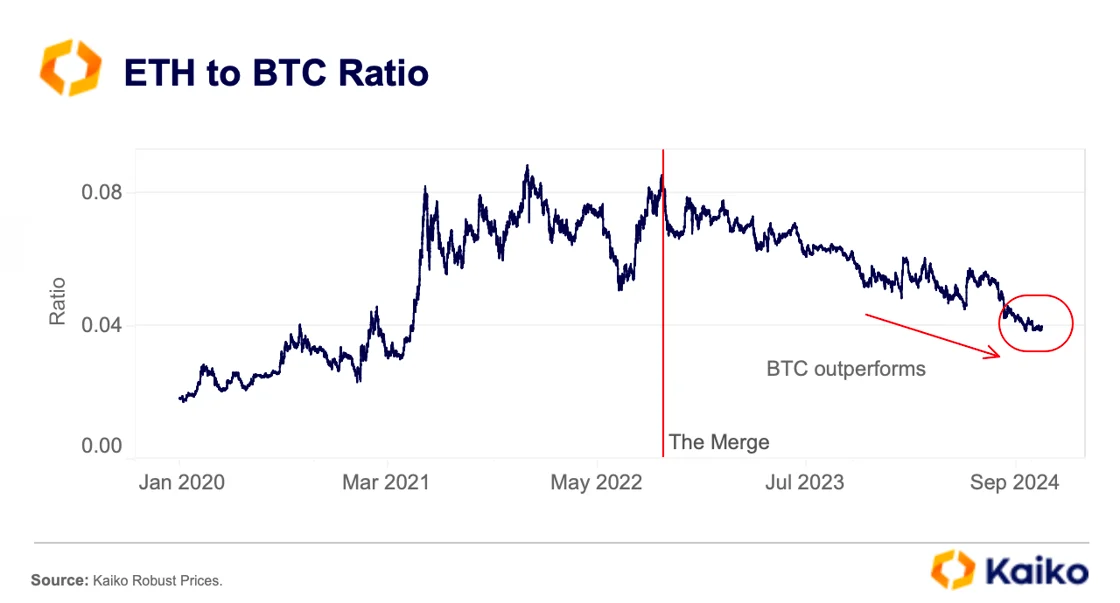
While Bitcoin ETFs have driven price discovery, Ethereum’s ETFs are driving infrastructure adoption. The lag in ETH’s price performance relative to BTC does not reflect a lack of utility but rather a market still adjusting to the reality that Ethereum is becoming the default settlement layer for global finance. As more institutions move from trading to settling on-chain, the network’s role as the backbone of programmable finance becomes increasingly undeniable.
Traditional settlement rails versus Ethereum infrastructure
The transition from legacy clearing houses to on-chain settlement represents a fundamental shift in market infrastructure. Traditional equity markets operate on a T+2 settlement cycle, meaning trades take two business days to finalize. This delay creates counterparty risk, ties up capital in margin requirements, and necessitates a complex web of intermediaries including clearing brokers, custodians, and depositories. Each layer adds friction, cost, and latency to the final transfer of ownership.
Ethereum functions as a unified settlement layer where trade execution and finality occur simultaneously. By leveraging smart contracts, the network enforces atomic settlement—T+0—where the exchange of assets and funds happens instantly upon trade confirmation. This eliminates the traditional settlement gap, reducing operational overhead and freeing up capital that would otherwise be locked during the clearing period. As former BlackRock executive Joseph Chalom notes, Ethereum is not merely another blockchain but the underlying infrastructure for future financial systems.
The following comparison highlights the structural differences between legacy equity settlement and Ethereum-based infrastructure.
| Feature | Traditional Equity Settlement | Ethereum Settlement Layer |
|---|---|---|
| Settlement Cycle | T+2 (2 business days) | T+0 (Instant finality) |
| Intermediaries | Multiple (Custodians, Clearing Houses, Brokers) | Smart Contract (Automated) |
| Counterparty Risk | High (Exposure during settlement period) | Minimal (Atomic settlement) |
| Capital Efficiency | Low (Margin requirements for T+2) | High (Immediate capital release) |
| Operational Cost | High (Manual reconciliation, fees) | Low (Gas fees only) |
This architectural advantage is particularly relevant for tokenized assets and institutional derivatives. While traditional systems require separate registries and reconciliation processes for different asset classes, Ethereum provides a single source of truth. This convergence allows for programmable money that settles instantly, regardless of the underlying asset. The result is a more efficient, transparent, and capital-efficient market structure that aligns with the speed of modern digital commerce.
Layer 2 Scaling for Enterprise Volume
Institutional adoption of Ethereum requires throughput that the base layer cannot sustainably provide. Layer 2 (L2) scaling solutions—specifically Arbitrum, Optimism, and Base—address this by processing transactions off-chain and posting compressed data to Ethereum. This architecture allows enterprises to handle high-frequency trading, settlement, and record-keeping without congesting the mainnet or incurring prohibitive gas fees.
The primary value proposition for institutional infrastructure is the "settlement layer" model. L2s function as execution engines, while Ethereum serves as the final arbiter of truth. This separation of duties ensures that while transaction speed and cost are optimized at the L2 level, security remains anchored to Ethereum’s proof-of-stake consensus. As noted by Ethereum developers, this structure provides politically neutral infrastructure for permissionless exchange, enabling global liquidity without compromising the integrity of the underlying network [ethereum.org].
Arbitrum and Optimism utilize optimistic rollup technology, assuming transactions are valid unless challenged by fraud proofs. Base, built by Coinbase, employs similar rollup mechanics but emphasizes integration with existing financial rails. For enterprise use cases, this means predictable transaction costs and high finality. The ability to batch thousands of transactions into a single on-chain proof reduces costs by orders of magnitude compared to Layer 1 execution, making complex financial instruments viable on-chain.
This infrastructure shift transforms Ethereum from a mere store of value into a scalable settlement layer. By offloading execution to L2s, institutions can participate in decentralized finance with the reliability and cost structure required for traditional finance operations, bridging the gap between open systems and enterprise-grade performance.
Regulatory clarity and SEC stance
The narrative of Ethereum as an unregulated frontier is dissolving under the weight of institutional compliance. Recent signals from the U.S. Securities and Exchange Commission (SEC) have shifted from ambiguity to explicit recognition of Ethereum’s technical standards. This regulatory clarity is not merely a legal formality; it is the foundational layer that allows traditional finance to treat Ethereum as a settlement infrastructure rather than a speculative asset.
The critical turning point involves the SEC’s acknowledgment of Ethereum-based standards as valid frameworks for on-chain law and settlement. By citing these standards, the agency has effectively validated the code that powers the network’s interoperability. This endorsement reduces legal risk for institutions that previously hesitated due to regulatory uncertainty. The focus is no longer on whether Ethereum is a security, but on how its infrastructure supports existing financial protocols.
This shift reframes the "conspiracy" of a hidden Wall Street takeover as a transparent structural evolution. Institutions are not bypassing regulations; they are embedding themselves within them. The SEC’s stance provides the legal certainty required for massive capital deployment. As the agency aligns its regulatory framework with Ethereum’s technical reality, the barrier to entry for traditional finance lowers significantly. The infrastructure is no longer a backdoor; it is the main road.
No comments yet. Be the first to share your thoughts!